

CCTV Camera: Definition, Types, Features & Price
A CCTV camera is a video surveillance device that captures footage of a specific area and transmits it to a monitoring or recording system. CCTV stands for Closed-Circuit Television and is used for security monitoring in homes, offices, retail stores, warehouses, commercial buildings and other facilities. CCTV cameras work by capturing images through a lens and image sensor, then transmitting video to a recorder, monitor or authorized viewing device. Common types include dome, bullet, turret, PTZ, IP and infrared cameras, with features such as night vision, motion detection, high-resolution recording and remote access.
In the UAE, CCTV prices vary according to camera type, resolution, brand and recording requirements. Businesses purchasing CCTV equipment in bulk must also consider storage capacity, installation costs and applicable security regulations. Dubai-based IT hardware supplier Crown Excel offers CCTV and security products for wholesale and commercial procurement.
What Exactly CCTV Means?
CCTV stands for Closed-Circuit Television. It is a video monitoring system in which cameras transmit footage to a designated set of monitors, recording devices or authorized users rather than broadcasting it openly to the public. CCTV systems are used to observe activities, monitor designated areas and record video that can be reviewed when necessary.
A CCTV system generally includes cameras, video transmission connections, recording equipment, storage and viewing software or monitors. Traditional CCTV systems commonly used analog cameras connected to recording equipment, while modern systems may use digital IP cameras connected through computer networks. Both approaches can support continuous monitoring and video recording.
What Is CCTV Surveillance?
CCTV surveillance is the use of cameras and recording systems to monitor activities in designated locations for security, safety and operational purposes.
It enables authorized personnel to view live footage, review recorded incidents and monitor areas such as entrances, corridors, parking facilities, retail spaces and warehouses. Surveillance systems may record continuously or according to configured schedules and events.
What Is CCTV Channel?
A CCTV channel is an input or supported camera connection within a video recording or monitoring system. In a DVR or NVR, a channel generally represents the ability to receive, display or record footage from one camera, although some systems have additional licensing or bandwidth limitations. Common CCTV recorder configurations include: 4-Channel Recorder, 8-Channel Recorder, 16-Channel Recorder, 32-Channel Recorder, 64-Channel Recorder.
How CCTV Camera Works?
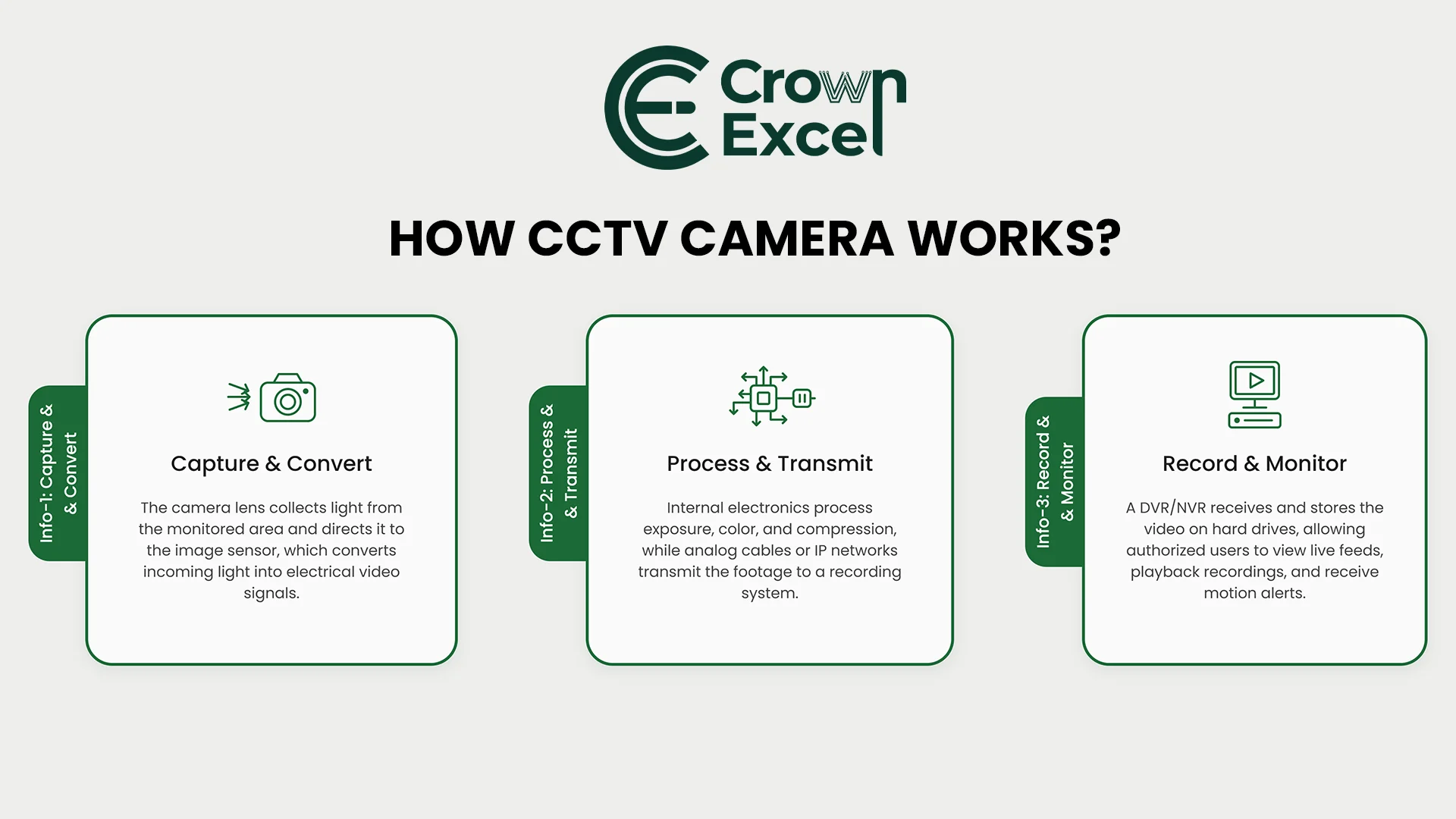
A CCTV camera works by capturing light from a monitored area, converting it into a video signal and transmitting the footage to a recording or viewing system. The camera uses a lens and image sensor to produce images, while internal electronics process the footage before it is displayed, stored or transmitted. Analog cameras send video signals to compatible recorders, whereas IP cameras convert footage into digital data for transmission across a network.
The CCTV recording process typically follows these steps:
Capture the Scene: The camera lens collects light from the area being monitored and directs it toward the image sensor.
Convert Light Into Image Data: The image sensor converts incoming light into electrical signals that are processed into video images.
Process the Video: The camera adjusts image characteristics such as exposure, colour and noise reduction. Digital cameras may also compress footage using formats such as H.264 or H.265.
Transmit the Footage: Analog cameras send signals through suitable video cables, while IP cameras transmit digital video through Ethernet or supported wireless connections.
Receive the Video: A digital video recorder (DVR), network video recorder (NVR) or video management system receives footage from compatible cameras.
Store the Recording: The system saves video to a hard drive, network storage or another configured recording destination.
Display Live or Recorded Video: Authorized users view footage through monitors, computers or compatible mobile applications.
Generate Alerts: Cameras or recording systems with supported analytics can notify authorized users when configured events, such as motion or line crossing, are detected.
What Are the Components of CCTV Camera?
The components of a CCTV camera include a lens, image sensor, image processor, circuit board, power circuitry and protective housing. These parts work together to capture, process and transmit video. A complete CCTV surveillance system also needs supporting equipment for recording, storage, power distribution, monitoring and network communication.
The main camera and system components include:
Camera Lens: Focuses incoming light onto the image sensor and determines the viewing angle.
Image Sensor: Converts light into electrical signals used to create video images. CMOS sensors are common in modern cameras.
Image Processor: Processes video data, including exposure, colour correction, noise reduction and compression.
Circuit Board: Connects and supports the electronic components inside the camera.
Camera Housing: Protects internal hardware from physical damage and environmental exposure.
Infrared LEDs: Provide infrared illumination for compatible night-vision cameras.
IR-Cut Filter: Helps maintain colour accuracy during daylight and supports infrared imaging when switched for night operation.
Power Circuitry: Regulates the electrical power supplied to the camera.
Network Interface: Enables digital cameras to transmit video through compatible wired or wireless networks.
Microphone: Captures sound in models that support audio recording, subject to applicable legal requirements.
Mounting Bracket: Holds the camera in its intended installation position.
Digital Video Recorder (DVR): Receives and records video from compatible analog camera systems.
Network Video Recorder (NVR): Receives and records digital streams from compatible IP cameras.
Hard Disk Drive (HDD): Stores recorded surveillance footage. Surveillance-rated storage is commonly used in continuous-recording systems.
Power Supply: Provides the required electrical power to cameras and associated equipment.
Power over Ethernet (PoE) Switch: Can transmit network data and compatible electrical power through Ethernet cables.
Coaxial Cable: Carries video signals in many analog CCTV installations.
Ethernet Cable: Connects IP cameras, network switches and recording equipment.
Monitor: Displays live or recorded video for authorized users.
Video Management Software (VMS): Provides functions for monitoring, camera management, searching recordings and controlling user access.
Uninterruptible Power Supply (UPS): Supplies temporary backup power during interruptions, depending on its capacity and connected equipment.
What Are the Types of CCTV Camera?
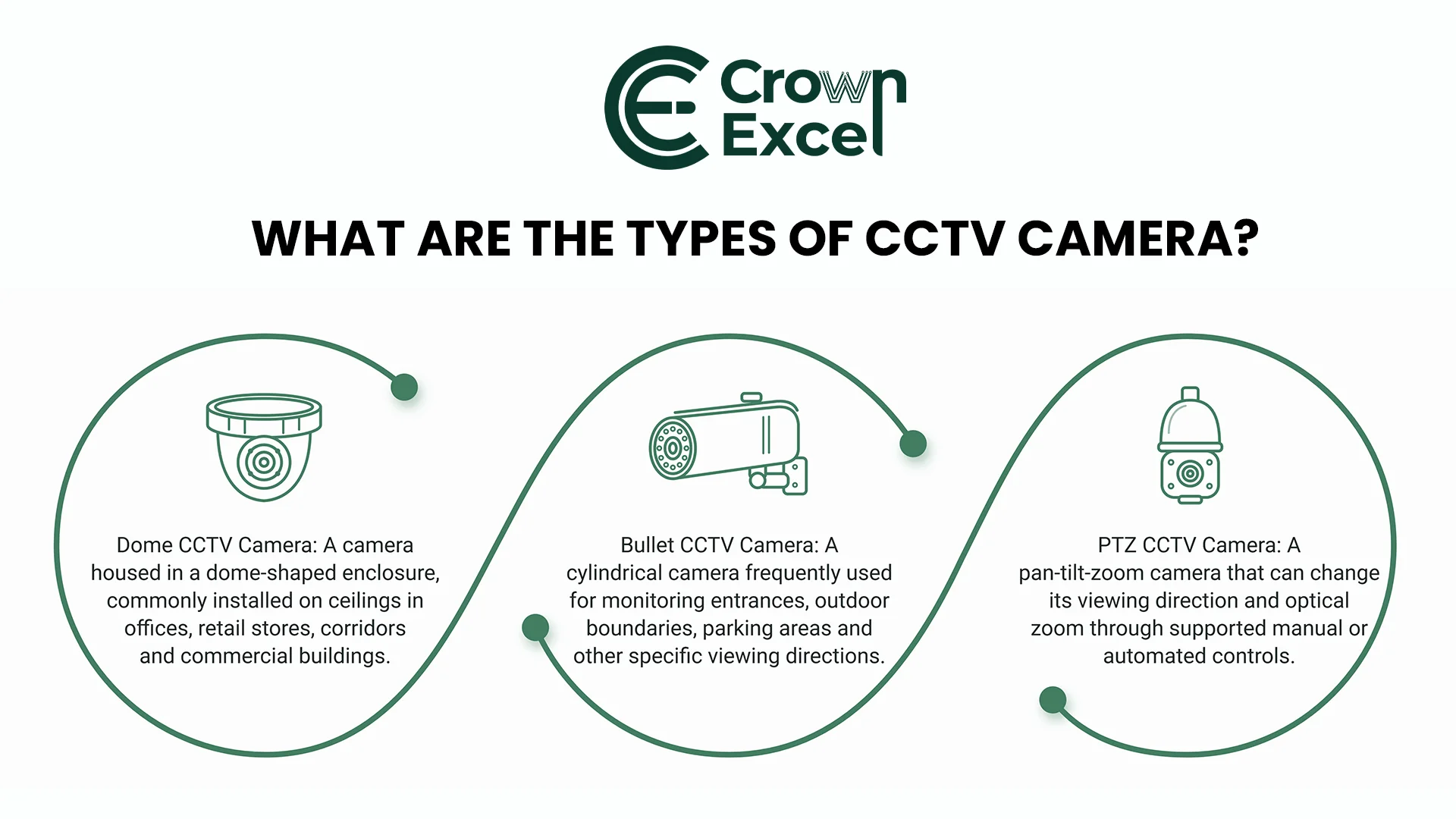
The types of CCTV cameras include dome, bullet, turret, PTZ, IP, analog, wireless, infrared, thermal and panoramic cameras. They are classified according to their physical design, video transmission technology, imaging capabilities and intended installation environment. Some categories overlap because a single camera can have several characteristics, such as an outdoor IP bullet camera with infrared night vision.
The main types of CCTV cameras are:
Dome CCTV Camera: A camera housed in a dome-shaped enclosure, commonly installed on ceilings in offices, retail stores, corridors and commercial buildings.
Bullet CCTV Camera: A cylindrical camera frequently used for monitoring entrances, outdoor boundaries, parking areas and other specific viewing directions.
Turret CCTV Camera: A compact camera with an adjustable ball-shaped camera head, suitable for indoor or outdoor surveillance depending on its protection rating.
PTZ CCTV Camera: A pan-tilt-zoom camera that can change its viewing direction and optical zoom through supported manual or automated controls.
IP CCTV Camera: A network-connected camera that converts footage into digital data and transmits it through compatible network infrastructure.
Analog CCTV Camera: A camera that sends video signals to a compatible DVR, commonly using coaxial cabling.
Wireless CCTV Camera: A camera that transmits video through a supported wireless connection. Many wireless models still require a wired power supply.
Infrared CCTV Camera: A camera equipped to capture images in low-light conditions using infrared illumination.
Thermal CCTV Camera: A camera that detects infrared radiation associated with temperature differences, useful for certain industrial and perimeter-monitoring applications.
Fisheye CCTV Camera: A wide-angle camera designed to capture a broad scene, often with a panoramic or circular view.
Multi-Sensor CCTV Camera: A camera containing multiple imaging sensors to provide coverage across different directions.
Box CCTV Camera: A camera with a rectangular body that may support interchangeable lenses and specialized protective enclosures.
Mini or Compact CCTV Camera: A small surveillance camera used in locations with limited mounting space, subject to applicable visibility and privacy requirements.
Varifocal CCTV Camera: A camera with an adjustable focal length that allows the field of view to be changed during installation or, in motorized models, remotely.
License Plate Recognition Camera: A specialized camera or imaging system configured to capture vehicle registration plates, often combined with automatic number plate recognition software.
What's the Difference Between CCTV & Security Camera?
The difference between a CCTV camera and a security camera is mainly terminology and system architecture. CCTV traditionally refers to cameras transmitting footage through a closed monitoring system, while security camera is a broader term for cameras used to monitor and protect an area. Many modern IP security cameras are also part of CCTV systems, so the terms frequently overlap.
| Feature | CCTV Camera | Security Camera |
|---|---|---|
| Meaning | Camera used within a closed-circuit surveillance system | General term for a camera used for security monitoring |
| Technology | Can use analog or digital IP technology | Can use analog, IP or wireless technology |
| Recording | Often connected to DVR, NVR or centralized video storage | May use a recorder, memory card, cloud storage or another system |
| Connectivity | Usually part of a designated surveillance network | Can be part of a local or internet-connected setup |
| Remote Viewing | Available on supported systems | Available on supported systems |
| Common Applications | Commercial buildings, warehouses, shops and offices | Homes, workplaces, buildings and outdoor locations |
What Is the History of CCTV Camera?
The history of CCTV cameras dates back to early closed-circuit television systems developed for specialized monitoring during the twentieth century. One important early application was a system installed at the German V-2 rocket testing facility at Peenemünde in 1942. Associated with engineer Walter Bruch, it allowed personnel to observe rocket launches from a protected location rather than standing near the launch area.
During the following decades, closed-circuit television expanded into industrial monitoring, commercial security and public surveillance. Early systems relied on analog video transmission and often required personnel to watch live monitors because practical recording equipment was limited. The development of videotape recording made it possible to preserve footage for later review, while advances in electronic imaging reduced camera size and improved reliability.
During the 1990s and 2000s, digital recording systems, DVRs, IP cameras and network-based monitoring changed CCTV technology. Digital video compression enabled recordings to be stored more efficiently, while network connectivity expanded remote access and centralized management. Modern CCTV cameras can support high-resolution imaging, low-light monitoring, event detection and AI-assisted video analytics.
The growth of network surveillance has also created demand for complete CCTV camera systems, recording equipment and bulk hardware procurement. Commercial buyers increasingly need compatible cameras, recorders, storage and network components rather than individual devices alone.
How CCTV Camera USED?
CCTV cameras are used to monitor designated areas, record activities, support incident investigations and improve awareness of safety and security conditions. Businesses use surveillance cameras to observe entrances, monitor inventory areas, review operational incidents and support security staff. Their effectiveness depends on suitable installation, recording quality and lawful monitoring practices.
The main uses of CCTV cameras include:
Home Security: Monitor entrances, driveways and other appropriate areas around residential properties.
Retail Stores: Observe entrances, sales floors and checkout areas for security and operational purposes.
Office Buildings: Monitor reception areas, entrances, corridors and other authorized locations.
Warehouses: Observe loading areas, inventory movement, access points and storage zones.
Parking Facilities: Monitor vehicle movement, entrances, exits and parking areas.
Schools and Educational Facilities: Support safety monitoring in areas where surveillance is lawful and permitted.
Hospitals and Healthcare Facilities: Monitor designated public and operational areas while respecting patient privacy.
Hotels: Observe appropriate entrances, lobbies, corridors and other common areas.
Industrial Facilities: Monitor machinery, restricted areas and safety-sensitive operations.
Construction Sites: Observe site access, stored equipment and selected work areas.
Banks and Financial Institutions: Support physical security and incident review around authorized monitoring locations.
Logistics and Transportation: Monitor loading docks, vehicle access and distribution operations.
Building Management: Support investigation of incidents and monitoring of shared facilities.
Incident Documentation: Preserve footage that may assist authorized personnel in reconstructing events.
Do You Provide CCTV Installation?
Crown Excel offers CCTV cameras and security-related hardware for commercial and bulk procurement in Dubai. Its publicly listed CCTV products include IP network cameras, outdoor bullet cameras, PTZ cameras and surveillance recording kits. However, direct CCTV installation by a Crown Excel team has not been clearly confirmed from its published product information.
Businesses requiring installation should confirm whether Crown Excel provides the service directly or through an appropriately licensed installation partner. In Dubai, CCTV installation and maintenance are regulated security activities, and the provider must hold the relevant Security Industry Regulatory Agency (SIRA) authorization. Buyers should verify installation scope, licensing, system commissioning, maintenance responsibilities and any required approvals before placing an order.
What Is the Importance of CCTV Cameras in UAE Business?
CCTV cameras are important for UAE businesses because they support security monitoring, incident documentation, access-point observation and the protection of commercial assets. Retail stores, offices, warehouses, hotels and other facilities use surveillance systems to monitor operations and assist authorized staff when reviewing security incidents.
CCTV systems are particularly relevant in Dubai, where the Security Industry Regulatory Agency regulates security services and establishes technical requirements for covered establishments. Dubai's 2025 Preventive Systems Manual contains standards for surveillance cameras, video recording, equipment protection, installation and maintenance. The requirements differ according to the type of facility and its activities.
For covered installations, the manual includes a baseline recording duration of at least 31 days, with longer periods required for certain categories of facilities. Businesses must determine the applicable requirements for their specific premises rather than assuming one retention period applies everywhere in the UAE.
Properly designed CCTV systems can help businesses review incidents, monitor restricted areas, document certain workplace safety events and support security operations. However, CCTV should be considered one part of a wider security strategy that may also include access control, alarms, physical protection, trained personnel and cybersecurity measures.
What Is the Future of CCTV?
The future of CCTV is moving toward AI-assisted video analytics, higher-resolution imaging, more efficient storage and improved integration with other security systems. Modern surveillance cameras are increasingly capable of detecting and classifying objects, distinguishing between people and vehicles, identifying movement patterns and generating event-based alerts. These technologies can help security teams review footage more efficiently, although their accuracy depends on camera positioning, environmental conditions and the capabilities of the software.
Cloud-connected and hybrid surveillance systems are also becoming more common. Hybrid systems combine local recording with selected cloud-based management functions, allowing organizations to manage cameras across multiple facilities without necessarily storing all footage online. Advances in video compression, cybersecurity and network management can further improve system efficiency. In the UAE, future CCTV adoption will also depend on security regulations, data protection requirements, equipment compatibility and the ability of businesses to maintain their surveillance infrastructure.
What Are the Features of CCTV Camera?
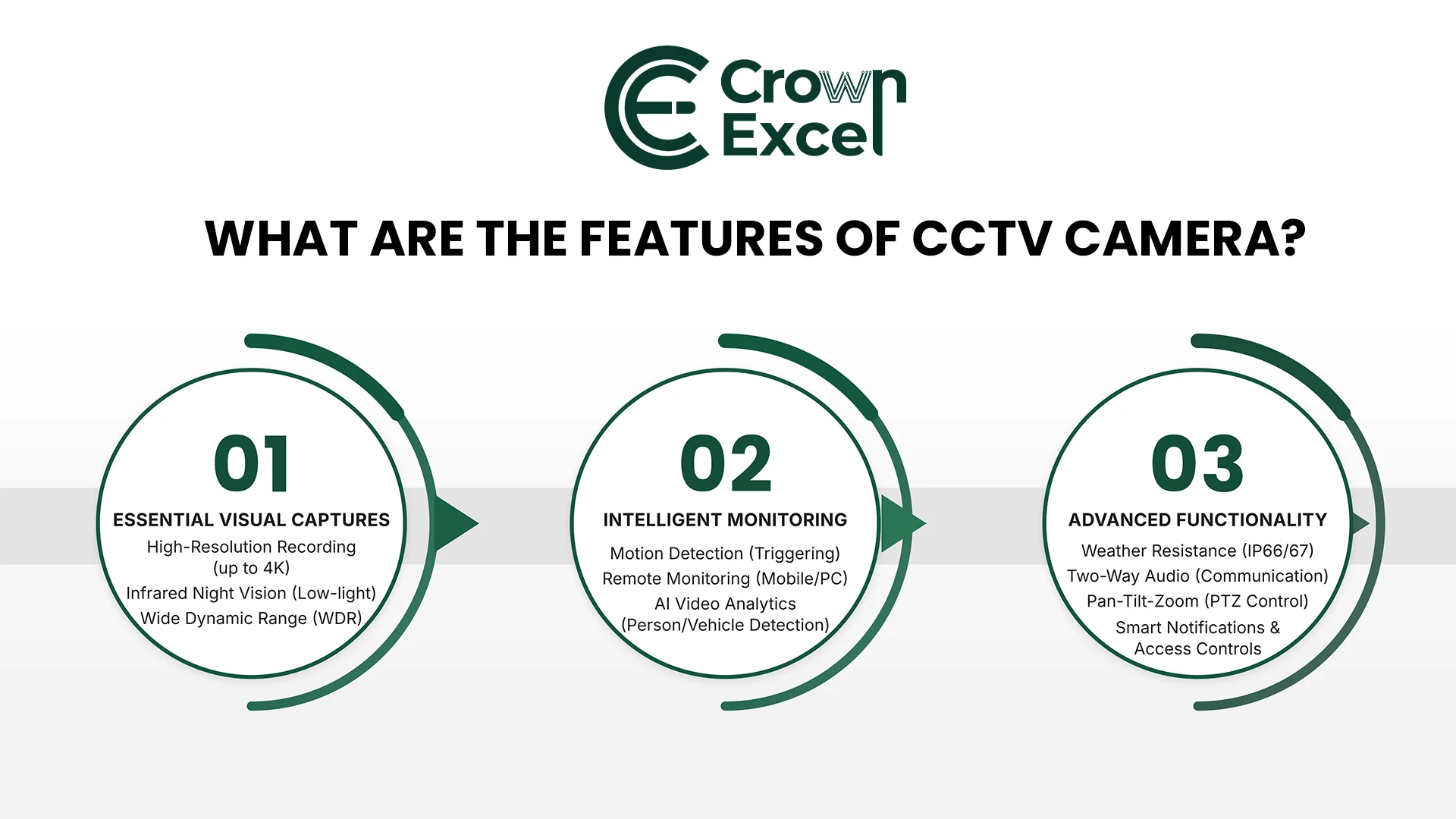
The features of CCTV cameras include high-resolution video, night vision, motion detection, remote monitoring, weather resistance and recording capabilities. Advanced cameras may also provide AI-assisted analytics, optical zoom, two-way audio and integration with other security equipment. Available features vary according to camera type, brand and model.
The main CCTV camera features include:
High-Resolution Recording: Captures video at resolutions such as 1080p (2MP), 4MP, 5MP or 8MP (4K), providing different levels of image detail.
Infrared Night Vision: Uses infrared illumination to capture images in low-light or dark environments.
Motion Detection: Detects movement within configured areas and can trigger recording or notifications.
Wide Dynamic Range (WDR): Helps maintain visibility in scenes containing both bright and dark areas.
Remote Monitoring: Allows authorized users to view compatible cameras through computers or mobile applications.
Weather Resistance: Protects outdoor cameras against dust and water exposure according to ratings such as IP66 or IP67.
Pan-Tilt-Zoom (PTZ): Allows compatible cameras to change viewing direction and optical zoom.
Power over Ethernet (PoE): Allows compatible IP cameras to receive power and network data through an Ethernet cable.
Video Compression: Uses formats such as H.264 or H.265 to reduce video storage and transmission requirements.
AI Video Analytics: Supports selected functions such as person detection, vehicle classification, line crossing and intrusion alerts.
Two-Way Audio: Enables communication through cameras equipped with compatible microphones and speakers.
Local Storage: Allows certain cameras to save footage directly to memory cards.
Cloud Connectivity: Provides supported remote management, recording or backup functions.
Tamper Detection: Generates alerts when certain changes to a camera's position or view are detected.
Optical Zoom: Changes image magnification through the camera lens while maintaining optical image detail.
Wide-Angle Coverage: Allows cameras with suitable lenses to monitor broader areas.
Smart Notifications: Sends alerts when configured events are detected.
Access Controls: Restricts video viewing and system management to authorized users.
What Is the CCTV Wholesale Price in UAE?
The CCTV wholesale price in the UAE varies according to resolution, camera type, brand, quantity, warranty and technical capabilities. Based on published indicative UAE market pricing for 2026, 4MP fixed IP cameras may cost approximately AED 180–700 per unit, depending on whether they are indoor dome, turret or outdoor bullet models. Advanced 8MP cameras and PTZ systems can cost substantially more. These ranges are indicative supplier-market estimates, not verified transaction averages or confirmed Crown Excel quotations.
The following table shows indicative wholesale equipment price ranges for the UAE.
CCTV Equipment | Indicative Wholesale Price (AED) |
|---|---|
4MP Indoor IP Dome or Turret Camera | 180–550 |
4MP Outdoor IP Bullet Camera | 230–700 |
8MP Outdoor IP Camera | 450–1,600 |
4MP PTZ Camera with Optical Zoom | 2,200–9,000 |
16-Channel NVR Without Storage Disk | 700–3,500 |
How to Choose the Right CCTV System
To choose the right CCTV system, identify the areas requiring surveillance, determine the number of cameras needed and select equipment based on image quality, coverage, recording capacity and environmental conditions. Commercial buyers in the UAE should also check applicable security regulations, equipment approval requirements, installation arrangements and long-term maintenance needs.
Follow these steps when selecting a CCTV system:
1. Identify Your Surveillance Purpose: Determine whether the system is intended for entrance monitoring, property protection, warehouse operations, retail security or another permitted purpose.
2. Calculate the Number of Cameras: Assess the layout, entrances, exits, corridors, blind spots and areas requiring coverage. Avoid assuming that a single wide-angle camera will provide sufficient identification detail everywhere.
3. Choose the Camera Type: Select dome or turret cameras for suitable indoor locations, weather-resistant bullet cameras for outdoor monitoring and PTZ cameras where controllable views are required.
4. Select the Required Resolution: Choose a resolution appropriate to the monitoring objective and viewing distance. Higher resolution may provide additional detail but cannot compensate for unsuitable lighting or camera placement.
5. Evaluate Night-Vision Performance: Consider infrared range, low-light image quality, external lighting and the actual distances being monitored.
6. Select a Compatible Recording System: Choose a DVR for compatible analog cameras or an NVR or VMS for supported IP cameras. Confirm channel capacity, recording throughput and integration capabilities.
7. Calculate Storage Requirements: Estimate recording storage using the number of cameras, resolution, frame rate, compression settings, daily recording duration and required retention period.
8. Check Networking and Power: Confirm PoE compatibility, network capacity, cable lengths, electrical requirements and backup power arrangements.
9. Verify Security and Privacy Features: Check authentication, access permissions, software update support, encryption options and controls for accessing or exporting recordings.
10. Review UAE Regulatory Requirements: In Dubai, determine whether the installation falls under SIRA requirements and the applicable provisions of the Preventive Systems Manual. Other emirates may impose different requirements.
11. Compare Warranty and Maintenance Support: Evaluate product warranties, repair arrangements, spare-part availability and the services provided by the supplier or licensed installation company.
12. Request a Complete Project Quotation: Compare the cost of cameras, recorders, storage, switches, cables, installation, commissioning and ongoing maintenance rather than considering only the camera unit price.